Technology for compact super-resolution microscopy

STED illumination and mode-selective photonic devices for fluorescence microscopes.

Technical focus

Control of illumination and detection modes at the microscope.

Peregrine Photon develops optical subsystems for the generation, delivery, registration, and detection of spatially structured light. The current technology base combines STED illumination with mode-selective few-mode fiber devices and can be integrated into new or existing microscope architectures.

Peregrine's current product work centers on STED illumination. Mode-selective photonic lanterns are an active research platform for compact beam delivery, spatial-mode generation, and mode-resolved detection.

STED

STED confines detectable fluorescence around a controlled intensity zero.

A diffraction-limited excitation point-spread function is coaligned with a red-shifted depletion field whose intensity vanishes at the target coordinate. Excited molecules outside that zero are driven back to the electronic ground state by stimulated emission before spontaneous fluorescence is recorded. The remaining fluorescent region is narrower than the excitation focus.

In a simplified steady-state description, the detected STED point-spread function is the excitation point-spread function multiplied by the spatially dependent probability that an excited molecule is not depleted.
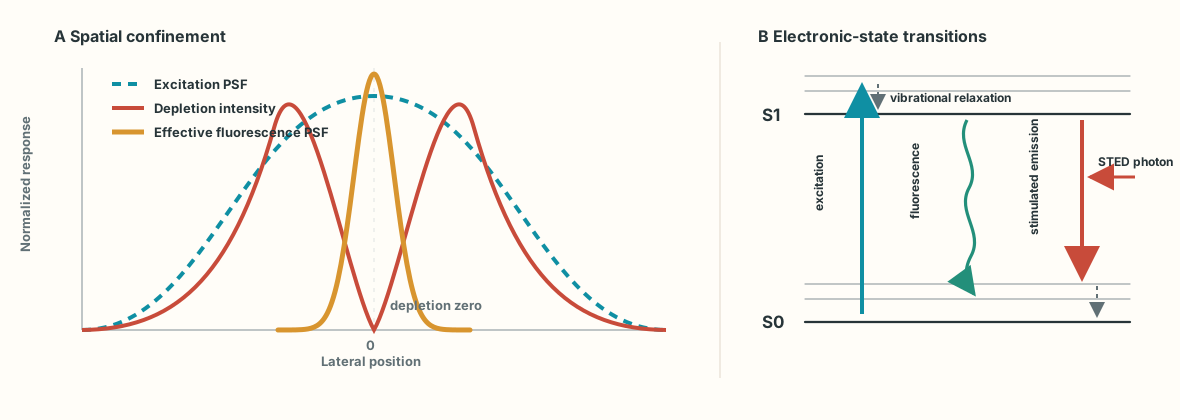
Conceptual STED figure showing excitation and depletion profiles, a narrowed effective fluorescence point-spread function, and an electronic-state diagram
Conceptual plot of the excitation point-spread function, depletion intensity, and effective STED fluorescence point-spread function
Electronic-state diagram showing excitation, fluorescence, and STED-driven stimulated emission
Conceptual STED mechanism, not to scale. The depletion field suppresses spontaneous fluorescence away from its central zero; stimulated-emission light and residual laser light are excluded from the fluorescence measurement.

Effective point-spread function

hSTED (r) hexc (r) 1 + ISTED (r) Isat h_{\mathrm{STED}}(r) \propto \frac{h_{\mathrm{exc}}(r)}{1 + I_{\mathrm{STED}}(r)/I_{\mathrm{sat}}}

This compact expression captures the local saturation term. It is not a complete forward model of a pulsed or continuous-wave STED experiment.

Field zero and registration

Residual depletion intensity at the zero suppresses wanted signal. Excitation, depletion, scanning, and detection must remain coaligned across the usable field.

Idealized resolution scaling

dSTED dconf 1 + ISTED Isat d_{\mathrm{STED}} \approx \frac{d_{\mathrm{conf}}}{\sqrt{1 + I_{\mathrm{STED}}/I_{\mathrm{sat}}}}

The square-root law describes saturation-limited scaling. Field quality, aberrations, background, photon budget, and sample stability determine the resolution that is usable in an image.

Mode-selective photonic lanterns

Single-mode ports are mapped to defined few-mode states.

A photonic lantern is an adiabatic transition between several single-mode channels and one multimode or few-mode waveguide. In a mode-selective lantern, the input channels are engineered so that each port maps preferentially to a defined output mode or mode group. Insertion loss, modal isolation, and wavelength dependence quantify the practical fidelity of that mapping.

Spatial-mode multiplexer

Separate single-mode ports are transformed into a controlled basis of guided spatial modes through an adiabatic taper.

Reciprocal operation

The same passive device can multiplex modes for illumination or demultiplex a collected field into mode-resolved detection channels.

Instrument relevance

Fiber-integrated mode generation provides a compact route to structured illumination, calibrated alignment states, and modal detection.

Research status

Visible-wavelength mode generation and mode-resolved confocal detection are active research directions.

Recent research · 2026

Visible mode generation and simultaneous multi-plane confocal detection.

Visible-wavelength mode selection

Ramadier and co-workers report a three-mode selective photonic lantern operating from 450-650 nm, with 0.20-0.41 dB insertion loss, modal isolation above 14.3 dB, and LP11 modal purity above 16.9 dB across the measured band.

Read the preprint

Simultaneous multi-plane detection

Becerra-Deana and co-workers use a four-port mode-selective photonic lantern with LP01, LP11, and LP21 mode groups for simultaneous multi-plane confocal detection, with reported trade-offs in resolution and field of view.

Read the preprint

Microscope integration

STED integration depends on the microscope architecture.

Peregrine modules can be integrated into upright, inverted, existing, or purpose-built microscope architectures where the optical interfaces and experiment permit it. Pupil access, scanning architecture, objective numerical aperture, wavelength compatibility, polarization, timing, mechanical stability, and laser safety are system-level constraints.

Constraint
What must be controlled
Why it matters
Optical access
Relay optics, pupil fill, dichroics, scanner conjugates, objective compatibility, and polarization.
The depletion pattern only matters if it is correct at the sample plane.
Timing and detection
Pulse or CW operation, detector gating where used, filtering, and rejection of depletion light.
The detector should see spontaneous fluorescence, not residual excitation or STED leakage.
Registration and stability
Excitation-depletion overlap, field dependence, drift, mechanical repeatability, and calibration.
The effective point-spread function is only useful while the optical channels remain registered.
Validation
Confocal/STED image pairs, reference structures, point-spread-function measurements, and controls.
Resolution claims require measurements tied to the instrument, acquisition, and sample.

System constraints

Performance is set by the complete optical path.

Nominal depletion power or magnification is not sufficient to specify resolution. Delivered field quality, co-registration, detection background, aberration, scan conditions, photon budget, and sample-induced mismatch determine the usable image.

Field fidelity

The depletion zero, pupil field, polarization, and wavefront must remain controlled at the sample, not only at an upstream alignment plane.

Detection background

Excitation leakage, depletion leakage, scatter, detector response, and timing errors reduce contrast and can bias apparent resolution.

Measurement conditions

Scan dwell, photon budget, refractive-index mismatch, drift, and sample stability define the operating point for a defensible image.

Selected references

Primary literature and technical reviews.

STED literature

  1. Stefan W. Hell and Jan Wichmann. Breaking the diffraction resolution limit by stimulated emission: stimulated-emission-depletion fluorescence microscopy. Optics Letters, 19(11), 780-782, 1994. doi:10.1364/OL.19.000780.
  2. Stefan W. Hell. Far-field optical nanoscopy. Science, 316(5828), 1153-1158, 2007. doi:10.1126/science.1137395.
  3. Katrin I. Willig, Benjamin Harke, Rebecca Medda, Stefan W. Hell. STED microscopy with continuous wave beams. Nature Methods, 4, 915-918, 2007. doi:10.1038/nmeth1108.
  4. Jan Keller, Andreas Schönle, Stefan W. Hell. Efficient fluorescence inhibition patterns for RESOLFT microscopy. Optics Express, 15(6), 3361-3371, 2007. doi:10.1364/OE.15.003361.
  5. Benjamin Harke, Jan Keller, Chaitanya K. Ullal, Volker Westphal, Andreas Schönle, Stefan W. Hell. Resolution scaling in STED microscopy. Optics Express, 16(6), 4154-4162, 2008. doi:10.1364/OE.16.004154.
  6. Steffen J. Sahl, Stefan W. Hell, Stefan Jakobs. Fluorescence nanoscopy in cell biology. Nature Reviews Molecular Cell Biology, 18, 685-701, 2017. doi:10.1038/nrm.2017.71.
  7. Wiebke Jahr, Philipp Velicky, Johann Georg Danzl. Strategies to maximize performance in STimulated Emission Depletion (STED) nanoscopy of biological specimens. Methods, 174, 27-41, 2020. doi:10.1016/j.ymeth.2019.07.019.

Photonic lantern literature

  1. Timothy A. Birks, Ian Gris-Sánchez, Sean Yerolatsitis, Samuel G. Leon-Saval, Robert R. Thomson. The photonic lantern. Advances in Optics and Photonics, 7(2), 107-167, 2015. doi:10.1364/AOP.7.000107.
  2. Rodrigo Becerra-Deana, Sarah Albos, Raphaël Maltais-Tariant, Nicole Tebchrany, Guillaume Ramadier, Caroline Boudoux. Few-mode confocal microscopy with a mode-selective photonic lantern. Optica Open preprint, 2026. doi:10.1364/opticaopen.31839976.
  3. Guillaume Ramadier, Rodrigo I. Becerra-Deana, Stéphane Virally, Nicolas Godbout, Caroline Boudoux, Lucien E. Weiss. Mode-Selective Photonic Lanterns for Visible Wavelengths. Optica Open preprint, 2026. doi:10.1364/opticaopen.33038456.
  4. Rodrigo Itzamná Becerra-Deana, Simon Desrochers, Raphaël Maltais-Tariant, Simon Brais-Brunet, Guillaume Ramadier, Stéphane Virally, Lucien E. Weiss, Caroline Boudoux. Simultaneous plane illumination and detection in confocal microscopy using a mode-selective photonic lantern. arXiv preprint, 2026. arXiv:2604.02494.

Technical inquiry

Discuss your microscope.

We can discuss illumination-module integration, custom microscope design, or research partnerships.

Contact us